
Table of Contents
- Why Etiquette Training Matters for Young Professionals in 2026
- Business Etiquette for Graduates Entering the Workplace
- Workplace Communication Etiquette: Meetings, Email and Hybrid Working
- Dining Etiquette for Business Meetings and Networking Events
- Remote, Neurodivergent and Financial Etiquette: The Gaps Most Training Misses
- How to Choose Etiquette Training That Delivers Real Results
- Conclusion
- Frequently Asked Questions
Last Updated: September 14, 2026
Why Etiquette Training Matters for Young Professionals in 2026
Etiquette training is the structured development of social intelligence, professional presence, and interpersonal skills that shape how others perceive you. This guide from Kensington House Academy examines why it matters for graduates and early-career professionals.
Hybrid working has made professional conduct harder to read and easier to get wrong. When your reputation is built through video calls, written messages, and occasional in-person meetings, the small signals once absorbed by osmosis must be learned deliberately.
First Impressions and Career Trajectory
First impressions form fast and are hard to reverse. A firm handshake, appropriate dress, and clear greeting set a baseline that follows you through probation reviews and promotion discussions.
What most guides miss is that first impressions in 2026 are often digital: your LinkedIn headline, email signature, and the way you open a video call all arrive before you do.
What Employers Actually Notice
Managers consistently notice reliability, tone, and how someone handles pressure. Technical skills get you hired; professional conduct determines whether you are trusted with clients and given room to grow.
Many organisations now run graduate development programmes that include professional conduct and workplace behaviour guidance from ACAS, because poor etiquette costs teams time, morale, and sometimes clients.
Business Etiquette for Graduates Entering the Workplace
Business etiquette for graduates is less about rigid rules and more about reading a room. The core principle: make other people feel comfortable and respected. What separates a graduate who settles in quickly from one who irritates a team is rarely one dramatic error, it is a pattern of small misreads across the first ninety days.
The First Ninety Days: A Practical Framework
Most new starters focus on being liked. The more useful goal is being predictable, that earns client exposure and stretch projects, because managers can hand you work without worrying how it will land.
A simple way to structure the first three months:
- Weeks 1-2, Observe. Learn the team’s actual norms, not the induction pack. Match the median behaviour, not the loudest person.
- Weeks 3-6, Contribute visibly. Volunteer for one small, unglamorous task and deliver it early. Reliability on something minor buys credibility for something major later.
- Weeks 7-12, Build one relationship outside your team. A colleague in another department who will tell you honestly how you come across is worth more than any handbook.
Professional Conduct and Workplace Decorum
Workplace decorum covers punctuality, dress codes, personal boundaries, and shared spaces. A common mistake is treating the office kitchen, the group chat, and the client meeting as the same environment. They are not.
- Arrive five minutes early to meetings, not exactly on time
- Keep phone notifications off in shared work areas
- Ask before borrowing equipment or adding people to group threads
- Match your dress to the most formal person in the room, then relax slightly
- Reply to a direct message before you reply to a group thread, the person waiting on you is the priority
One area graduates underestimate is the probation review, the first formal record of how you are perceived. Ask your line manager for one specific piece of feedback at the four-week mark and act on it visibly. Being seen to respond to feedback is itself a form of professional conduct.
Building Confidence and Self-Awareness
Confidence in professional settings comes from preparation, not personality. People who seem at ease have usually rehearsed the basics: introductions, small talk openers, and how to exit a conversation politely.
Prepare three tiers of small talk so you are never caught flat-footed:
- Safe openers, the weather, the journey in, the venue. Low risk, universally acceptable.
- Context openers, the event you are both attending, a shared project, a recent industry announcement.
- Personal openers, weekend plans, a book or podcast, a hobby. Use these only once the other person has signalled openness.
Record yourself on a video call once. Watching it back is uncomfortable but it reveals filler words, posture, and facial expressions you cannot notice in real time.
What Employers Actually Notice
Managers consistently notice reliability, tone, and how someone handles pressure. Technical skills get you hired; professional conduct determines whether you are trusted with clients and given room to grow.
Many organisations now run graduate development programmes that include professional conduct and workplace behaviour guidance from ACAS, because poor etiquette costs teams time, morale, and sometimes clients. The pattern is consistent: the graduate who asks a clarifying question early is trusted more than the one who guesses and delivers the wrong thing confidently.
Handling the Awkward Moments
No framework covers everything. A few situations trip up almost every new starter:
- You are copied into an email chain you do not understand. Do not reply-all to ask. Reply to the sender only, or ask a colleague in person.
- A senior colleague makes a joke you do not find funny. A brief smile and a change of subject is almost always correct. Do not perform amusement, and do not challenge it in the moment.
- You realise you have made a mistake. Flag it early, own it plainly, and propose a fix. Concealment is the only unforgivable version of an error.
- Someone takes credit for your work in a meeting. Correct the record calmly and factually, once. “Just to add context, I led that piece, and the key finding was…” Then move on.
Good etiquette is not about never being uncomfortable. It is about managing discomfort without transferring it to everyone else in the room.
Workplace Communication Etiquette: Meetings, Email and Hybrid Working
Workplace communication etiquette is the set of conventions that keep collaboration clear and respectful across meetings, written messages, and remote work. Getting it right protects your reputation.
Digital Professionalism and Virtual Meeting Standards
Digital professionalism means treating every channel with the same care you would apply in person. Test your camera and microphone before a client call, join two minutes early, and mute when not speaking.
Email remains where young professionals most often lose credibility. Reply within one working day, use a clear subject line, and never send a message written in anger.
Active Listening and Non-Verbal Communication
Active listening means giving full attention, confirming understanding, and responding to what was actually said rather than what you expected to hear. It is the most underrated skill in early-career development.
Non-verbal communication carries much of the message: eye contact, posture, and tone. On video calls, look at the camera when speaking, not at your own image.
| Channel | Response Time | Formality | Watch Out For |
|---|---|---|---|
| Email to client | Within 1 working day | High | Tone misread as curt |
| Internal email | Same day | Medium | Over-long threads |
| Instant message | Within a few hours | Low | Jokes landing badly |
| Video call | Join 2 minutes early | Medium | Background and lighting |
Dining Etiquette for Business Meetings and Networking Events
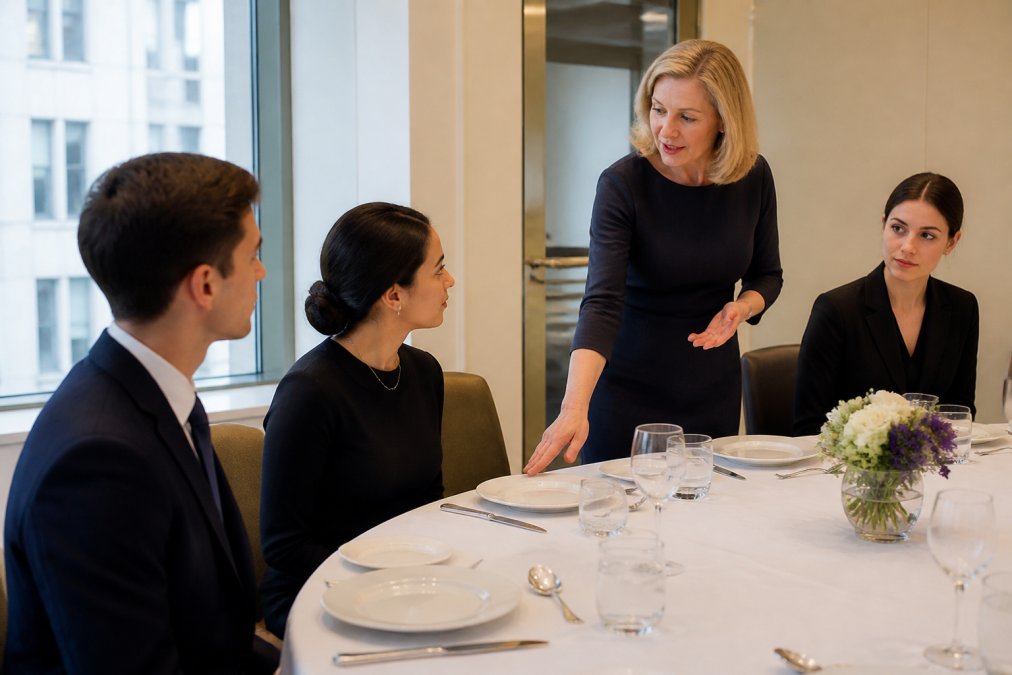
Dining etiquette for business meetings rests on one rule: the meal is not the point, the relationship is. Order something easy to eat, keep pace with the table, and let the conversation lead.

A few practical points: wait until everyone is served before starting. Place your napkin on your lap, not tucked into your collar. Hold cutlery in the continental style, fork in the left hand and knife in the right, and rest them on the plate when you pause.
Never discuss salary, politics, or personal grievances over a business meal. One careless remark at a networking lunch can undo months of good work.
Remote, Neurodivergent and Financial Etiquette: The Gaps Most Training Misses
Traditional etiquette courses rarely address the situations that trip up modern professionals. Three areas deserve specific attention, and they are precisely the areas most competitors skip entirely.
Remote and Hybrid Work Etiquette
Remote work removes the ambient signals that once taught professional norms by osmosis. Nobody sees how you greet a colleague in the kitchen, so nobody can correct you gently, and small habits calcify into reputations.
A few rules that hold up across video platforms:
- Camera on by default, off by agreement. Turning your camera off in a one-to-one without explanation reads as disengagement. In a large all-hands, it is usually fine.
- Mute unless speaking, and unmute before you start talking. The half-second delay is less disruptive than background noise.
- Name yourself properly. “iPhone” or “User 4821” in a client call signals carelessness before you have said a word.
- Look at the lens, not the screen, when you are making a point. It is the closest digital equivalent of eye contact.
- Do not multitask visibly. Scrolling, typing, or glancing off-screen is more obvious on camera than most people realise.
Assume every video call may be recorded. Speak and behave as if it will be reviewed later, because increasingly, it is.
Written channels carry their own risks. Instant messages are not email, and email is not a letter. A useful rule: if a message would embarrass you read aloud in a meeting, do not send it in writing at all.
Etiquette for Neurodivergent Professionals
Standard advice assumes a neurotypical baseline. For professionals with autism, ADHD, or social anxiety, “just be yourself” and “read the room” are not useful instructions, they are instructions to perform a skill that has not been taught.
A more practical framework focuses on scripts and systems:
- Prepare three opening lines for networking events and rehearse them aloud until they feel automatic. The goal is not spontaneity; it is removing the cognitive load of the first ten seconds.
- Set a reminder to make eye contact periodically rather than constantly. Sustained eye contact is not required for warmth; intermittent eye contact with a relaxed expression reads as attentive.
- Ask a trusted colleague for direct feedback on how you come across, because indirect hints are easy to miss and rarely offered twice.
- Agree a signal with your manager for when a meeting has run long or a topic needs a follow-up in writing. This protects you without requiring you to interrupt.
- Use written follow-ups. A short summary after a verbal conversation is not a weakness; it is a professional habit many neurotypical colleagues would benefit from too.
Good etiquette training now recognises that different people need different supports, not different standards. The standard is the same, respect, clarity, reliability. The route to it is not.
Financial Etiquette at Work
Financial etiquette covers how you handle money conversations at work: splitting bills, discussing pay, and managing expenses. It is the gap most guides ignore, and where young professionals most often cause quiet offence.
- Splitting a bill. If you suggested the venue, expect to cover the difference if the split is uneven. Do not itemise your own order in front of the table.
- Discussing pay. It is lawful to discuss your own pay with colleagues, and doing so is often how pay gaps are corrected. But raising someone else’s salary in a group setting puts them in an awkward position they did not choose.
- Expenses. Submit them promptly and accurately. Padding an expense claim, even slightly, is the fastest way to lose a manager’s trust permanently.
- Gifts and leaving collections. Contribute what you can afford, discreetly. A card signed by everyone matters more than the amount inside it.
- Tipping. For a business meal, check whether service is already included before adding a discretionary amount. Double-tipping is not generous; it is a sign you did not read the bill.
AI-Assisted Professionalism
AI-assisted professionalism is the newest gap. Using AI to draft an email is fine. Sending an AI-generated message without reading it is not. Always review for tone, accuracy, and anything that sounds unlike you.
A practical test before you send anything AI-assisted:
- Would I say this out loud to the recipient? If not, rewrite it.
- Is every factual claim verifiable? AI tools can produce confident, plausible, and wrong statements.
- Does it sound like me? A generic message undermines the relationship it was meant to build.
- Have I removed anything confidential? Do not paste client names, figures, or internal documents into a public AI tool.
According to guidance from the Information Commissioner’s Office on using AI at work, professionals remain responsible for the content they send, regardless of how it was produced. That single principle resolves most AI etiquette questions: the tool is not accountable, you are.
The common thread across remote, neurodivergent, financial, and AI etiquette is the same: etiquette is not a fixed script. It is the deliberate management of how your behaviour lands on other people, and that responsibility does not transfer to a platform, a diagnosis, or a chatbot.
How to Choose Etiquette Training That Delivers Real Results
The right etiquette training programme should change how you behave under pressure, not just what you know. Look for practical rehearsal, feedback, and content that addresses hybrid and digital settings.
At Kensington House Academy, our courses are delivered through Kensington School of Etiquette and Manners, with both online programmes and face-to-face sessions. Our Train the Trainer course, Become a Certified International Etiquette Consultant, suits those who want to turn good manners into a profession.
Online vs In-Person: What Works for Your Schedule
Online training suits professionals who need flexibility. In-person training suits those who want direct feedback on posture, voice, and presence.
| Format | Best For | Time Commitment | Feedback Style |
|---|---|---|---|
| Online courses | Remote workers, busy schedules | Self-paced modules | Written and video review |
| In-person sessions | Client-facing roles, leadership tracks | Scheduled sessions | Live coaching and correction |
| Train the Trainer | Aspiring etiquette consultants | Extended programme | Certification pathway |
If you are unsure which fits, start with the format that matches how you will actually use the skills. A remote worker who never meets clients in person gains less from a dining-focused course.
Conclusion
The professionals who advance fastest are rarely the most technically gifted. They are the ones who make others feel at ease, communicate clearly, and carry themselves with quiet confidence. Etiquette training builds those habits deliberately rather than leaving them to chance.
Kensington House Academy offers online and in-person programmes through Kensington School of Etiquette and Manners, alongside eBooks and paperbacks on refinement, communication, and elegant living. Our free membership includes exclusive tips, reading recommendations, and readers’ gatherings. Get started with Kensington House Academy and build the professional presence that opens doors.
Frequently Asked Questions
What are the core pillars of professional etiquette in the workplace?
Four pillars hold up professional etiquette: respect, awareness, consistency and adaptability. Respect covers punctuality, active listening and treating everyone from the receptionist to the CEO with the same courtesy. Awareness means reading a room and adjusting your tone. Consistency builds trust because colleagues know what to expect. Adaptability matters when you move between a video call, a client lunch and a formal presentation. Etiquette training for young professionals typically builds all four through practice, feedback and real scenarios rather than lectures alone.
How does business etiquette for graduates impact career progression?
Graduates who master workplace decorum tend to integrate faster and get trusted with client-facing work sooner. Employers read small signals, such as how you greet a visitor, how you handle a mistake or how you behave when a meeting runs over. These signals shape leadership potential in the eyes of managers. Business etiquette for graduates is less about rigid rules and more about making other people feel comfortable, which is exactly what promotion panels look for when assessing whether someone is ready for more responsibility.
Are there specific etiquette standards for virtual meetings and hybrid working?
Yes, and they differ from in-person norms. Join early, test your audio, mute when not speaking and keep your camera at eye level. Use your full name on screen so external guests know who is talking. In hybrid meetings, repeat questions from the room for remote attendees and address people by name so nobody is sidelined. Workplace communication etiquette also covers response times, keeping chat channels on topic and not scheduling calls outside agreed working hours. These habits build digital professionalism quickly.
Is etiquette training just about which fork to use, or does it help in modern business?
The fork question comes up often, and the honest answer is that dining etiquette for business meetings is a small part of a much bigger picture. Modern training covers how to introduce yourself, how to run a meeting, how to give feedback, how to handle a client dinner without anxiety and how to communicate across cultures. The cutlery is simply a visible test of whether you can stay calm and observant under pressure. The real skill being assessed is composure.
I get anxious in social situations. Is etiquette training suitable for me?
It is often more useful for people who feel anxious than for natural extroverts. Etiquette gives you a structure to fall back on: a way to greet someone, a set of questions to ask, a clear exit from a conversation. Knowing the expected behaviour removes the guesswork that fuels anxiety. Training programmes usually build confidence gradually through small, repeated practice, and many include online options so you can start in a lower-pressure environment before moving to in-person sessions.
How much time does etiquette training take, and can I fit it around work?
Most programmes are built for working adults. Short courses run over a day or a few evenings, while longer certification paths spread across several weeks with self-paced modules. A realistic commitment is two to four hours per week if you want visible change within a couple of months. Look for training with online components so you can study around deadlines and family commitments. Pricing and scheduling vary by course, so check the provider’s website for current options and availability.
What is the difference between social grace and professional protocol?
Social grace is how you make people feel at ease: warmth, timing, genuine interest and reading unspoken cues. Professional protocol is the agreed framework for a given setting, such as who speaks first in a boardroom or how to address a senior client. The two overlap constantly. Someone with social grace but no protocol can still misstep in a formal setting, and someone who knows every rule but lacks warmth reads as cold. Effective etiquette training develops both together.
How can young professionals improve their networking etiquette?
Start with preparation: know who will be in the room and have two or three genuine questions ready. Introduce yourself with your name, role and a reason you are there. Listen more than you speak, and follow up within 48 hours with a short, specific message referencing something you discussed. Networking proficiency also means respecting boundaries, not dominating a conversation and knowing when to move on politely. Over time, these small habits build a professional network that actually supports your career trajectory.